

Counterfeit vinyl records are more prevalent than most collectors realize. As vinyl prices have surged—with rare pressings regularly selling for four and five figures—the financial incentive to produce fakes has grown proportionally. From sophisticated reproductions of rare first pressings to mass-produced bootlegs falsely marketed as originals, the modern collector faces authentication challenges that didn’t exist a decade ago.
This guide equips you with the practical skills to identify fake vinyl records, covering physical inspection techniques, common fraud patterns, and technological tools that tilt the odds in your favor.
The Scale of the Problem
The counterfeit vinyl market has evolved significantly in recent years. What was once limited to obvious bootleg live recordings has expanded into three major categories:
Types of Fake Vinyl Records
| Type | Description | Risk Level |
|---|---|---|
| Counterfeit pressings | Records manufactured to replicate specific rare originals, including fake labels and covers | High — designed to deceive |
| Unauthorized bootlegs | Unofficial releases of unreleased material, live recordings, or alternative mixes | Medium — often acknowledged as unofficial |
| Misrepresented reissues | Legitimate reissues fraudulently described as original first pressings | High — most common fraud |
| Upgraded condition | Genuine records with artificially improved appearance (cleaned, filled scratches) | Medium — hard to detect visually |
Most common fraud: The single most prevalent deception isn’t manufacturing a fake record—it’s selling a common reissue as a valuable first pressing. This requires minimal effort from the seller and relies entirely on the buyer’s inability to distinguish pressings.
Physical Inspection: The Dead Wax
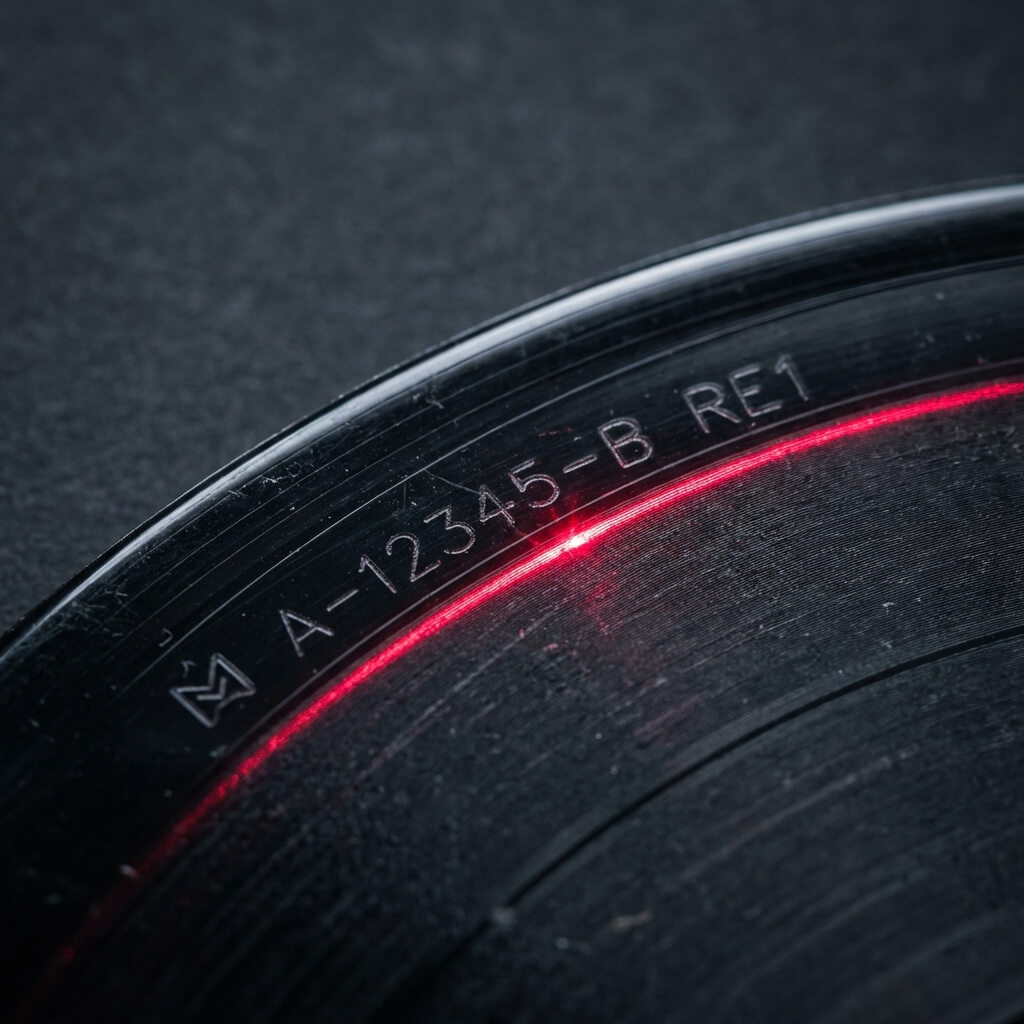
The dead wax (also called run-out groove or trail-off area) is your single most powerful authentication tool. This smooth area between the last groove and the label contains information that is extremely difficult to replicate convincingly.
What to Look For in the Dead Wax
-
Matrix numbers: Machine-stamped or hand-etched codes identifying the master lacquer, pressing plant, and production run. Authentic matrix numbers should match documented records in databases like Discogs.
-
Stamper codes: Letters or numbers indicating which stamper was used. First pressings typically show early stamper codes (A, B, or 1, 2).
-
Engineer inscriptions: Hand-etched messages or initials from mastering engineers. For example, Robert Ludwig’s “RL” etching on original Led Zeppelin II pressings is a famously authenticated detail.
-
Pressing plant identifiers: Codes revealing which plant manufactured the record. Examples include “PR” for Presswell, “MO” for Monarch, “SP” for Specialty Records.
Red Flags in the Dead Wax
- Blurry or shallow etchings: Authentic matrix numbers are typically crisp and consistent in depth. Counterfeits often show uneven or artificially reproduced markings.
- Missing information: Legitimate pressings almost always contain multiple pieces of dead wax information. A suspiciously clean dead wax with only a matrix number may indicate a counterfeit.
- Inconsistent formatting: If the matrix number style doesn’t match the pressing plant’s documented conventions for that era, investigate further.
- Digital font etching: Some modern counterfeits use laser-etched matrix numbers that look unnaturally precise compared to the hand-etched or mechanical stamps used in original pressings.
Label Inspection
Labels are the second most important area for authentication. Counterfeiters frequently get label details wrong because the variations are complex and era-specific.
Key Label Authentication Points
Color accuracy: Original labels used specific ink formulations that are difficult to replicate exactly. For example:
- Blue Note’s iconic deep blue labels from the 1950s have a specific shade that modern reproductions rarely match precisely.
- Columbia’s “six-eye” labels have a distinct red coloring that fades differently than modern reprints.
Typography: Original labels used specific typefaces set on printing presses. Counterfeits often use digital approximations that differ subtly in letter spacing, weight, or baseline alignment.
Print quality: Examine the label under magnification. Authentic labels from major pressing plants show consistent, high-quality printing. Counterfeits may show:
- Dot-matrix patterns (visible under 10x magnification) indicating digital printing
- Inconsistent ink density
- Slightly blurry text edges
- Color registration errors
Label positioning: Authentic labels are applied with industrial precision. Counterfeits may show:
- Off-center label placement
- Wrinkles or bubbles under the label
- Labels that don’t sit flush with the record surface
Era-Specific Label Guides
Knowing the correct label design for a given era is essential. Major labels changed designs frequently:
| Label | Era | Key Identifier |
|---|---|---|
| Blue Note (US) | 1955-1962 | Deep groove, Lexington Ave address, ear microphone logo |
| Blue Note (US) | 1963-1966 | No deep groove, New York USA address, Division of Liberty |
| Columbia (US) | 1955-1962 | ”Six-eye” design with six CBS logos around perimeter |
| Columbia (US) | 1962-1965 | ”Two-eye” design with two CBS logos |
| Parlophone (UK) | 1963-1964 | Gold/black label with “The Parlophone Co. Ltd.” |
| Atlantic (US) | 1958-1961 | Black label with Broadway address |
Vinyl Quality Assessment
The physical record itself contains authentication clues that counterfeits struggle to replicate.
Weight and Feel
- Vinyl weight: Original pressings from the 1960s-70s typically used heavier, higher-quality vinyl compounds. A suspiciously lightweight pressing of a supposedly original 1960s record warrants investigation.
- Vinyl color: Hold the record up to a strong light source. Original pressings generally use deep black virgin vinyl that doesn’t allow light through. Records pressed from recycled vinyl (common in counterfeits) may show a slightly brown or translucent quality.
- Edge quality: Examine the record’s edge. Factory-pressed records have clean, consistent edges. Counterfeits may show rough or uneven edges from inferior pressing equipment.
Groove Quality
- Surface noise pattern: Authentic vintage records have a characteristic surface noise profile. An alleged 1960s pressing that sounds suspiciously quiet (like a modern pressing) may be a contemporary counterfeit pressed from a digital master.
- Dynamic range: Original analog pressings maintain dynamic range throughout. Counterfeits pressed from digital sources often show digital compression characteristics audible to experienced listeners.
Cover and Packaging Authentication
Album covers contain numerous authentication details that counterfeiters frequently overlook or get wrong.
Cover Inspection Points
-
Paper stock: Original covers used specific paper weights and textures. Modern reproductions often use different paper stock that feels smoother or thinner.
-
Print quality: Authentic covers from the 1960s-70s were printed using offset lithography, producing a characteristic dot pattern visible under magnification. Modern digital printing produces a fundamentally different pattern.
-
Spine text: The printing on album spines often contains era-specific formatting (font, layout, label logo) that counterfeiters overlook. Always check that spine text matches documented examples.
-
Back cover details: Credits, catalog numbers, barcode presence/absence, and address information should all be period-appropriate.
-
Inner sleeves: Original inner sleeves are frequently overlooked by counterfeiters. The presence of correct, era-appropriate inner sleeves adds significant authentication confidence.
Packaging Red Flags
- New-looking cover on a “1960s original”: Genuine 50+ year old covers show age-appropriate wear. A pristine cover on an alleged original should raise questions.
- Modern barcode on pre-1980 releases: Barcodes weren’t introduced to vinyl until the early 1980s. Their presence on earlier releases indicates a reissue.
- Incorrect catalog number formatting: Each label used specific catalog number conventions by era. Cross-reference with documented releases.
Digital Verification Tools
Physical inspection is essential, but modern technology provides powerful additional verification layers.
Using DiscSnap for Authentication
DiscSnap’s AI visual recognition cross-references multiple data points simultaneously:
- Label design matching: The AI compares label artwork, typography, and color against a comprehensive database of verified releases, flagging inconsistencies.
- Cover art analysis: Visual comparison against documented editions can reveal reproduction artifacts invisible to the naked eye.
- Pressing identification: Instant identification of the specific pressing helps verify whether a record’s claimed provenance matches its actual characteristics.
This is particularly valuable in time-sensitive purchasing environments (record fairs, estate sales) where extended manual authentication isn’t practical.
Online Verification Resources
- Discogs release pages: Cross-reference every detail against community-contributed images and descriptions for the specific pressing.
- Pressing plant databases: Verify that matrix number formatting matches the pressing plant’s documented conventions.
- Collector forums: The Steve Hoffman Music Forums and Discogs forums have extensive threads documenting known counterfeits.
Known Counterfeit Hot Spots
Certain records are counterfeited more frequently due to their high value. Exercise extra caution with:
- The Beatles — Butcher cover (Yesterday and Today), early Parlophone pressings
- Led Zeppelin — Turquoise lettering first pressing of Led Zeppelin I
- Pink Floyd — UK first pressings of The Dark Side of the Moon and The Wall
- Blue Note jazz — Any original deep groove pressing valued over $500
- Sex Pistols — A&M pressing of “God Save the Queen” (one of the most counterfeited records in history)
- Velvet Underground — “Banana cover” with peelable sticker (reproductions are rampant)
Frequently Asked Questions
How can I tell if a vinyl record is real?
Authenticate by examining the dead wax area for correct matrix numbers, inspecting label typography and color accuracy, checking vinyl weight and quality, and verifying cover details against documented examples. Cross-reference all details with Discogs release pages and use tools like DiscSnap for visual verification.
Are bootleg vinyl records illegal?
Unauthorized bootlegs violate copyright law in most jurisdictions. However, enforcement varies widely and many bootlegs circulate openly in collector markets. The legality differs from counterfeits—bootlegs typically contain unique or unreleased content, while counterfeits replicate existing official releases to deceive buyers.
How common are fake vinyl records?
Counterfeit concerns primarily affect high-value records (typically $200+). Common, inexpensive records are rarely worth counterfeiting. The most common form of deception isn’t outright counterfeiting but misrepresenting reissues as original first pressings—a problem affecting potentially 10-15% of online listings for valuable titles.
Can AI detect fake vinyl records?
AI visual recognition tools like DiscSnap can identify pressings by analyzing label design, cover artwork, and visual characteristics against comprehensive databases. While AI can flag inconsistencies and verify pressing details, final authentication of high-value records should combine AI tools with physical inspection and expert consultation.
What should I do if I bought a fake record?
Document the counterfeit indicators, contact the seller for a refund, and report the listing on the platform where you purchased it. Most reputable marketplaces (Discogs, eBay) have buyer protection policies for counterfeit goods. Share your findings in collector forums to alert the community.
Protect Your Collection
The best defense against counterfeits is knowledge. By understanding what to look for in dead wax markings, label details, vinyl quality, and packaging, you can evaluate records with confidence—whether you’re browsing a record fair or evaluating an online listing.
Technology amplifies your expertise. Download DiscSnap to add AI-powered visual verification to your authentication toolkit, and make informed purchasing decisions before money changes hands.