
To identify a vinyl record label, record the imprint, catalog number, track credits and rim text on both sides, then compare that combination with a documented release. Label color alone cannot establish a first pressing, manufacturing country or value. The most useful detail is often a small difference in a publisher credit or company address that rules out an otherwise convincing match.
There are also two meanings of “record label.” One is the company or imprint releasing the music. The other is the paper label at the center of the disc. This guide is about reading the physical label as evidence. It helps you narrow an edition before you move to its runouts, sleeve and condition.
Start with the disc, not the jacket
Remove the record carefully and keep fingers away from the playing surface. Place it in or on a clean inner sleeve while taking photographs. A jacket may have been replaced, and a double album may contain discs from different editions. Beginning with the paper labels prevents a sleeve’s attractive artwork from deciding the identification prematurely.
Take a straight-on photograph of each side in even light. Fill the frame with the label, but include enough surrounding vinyl to show the pressing rings and spindle hole. Avoid a flash reflection that hides small text. Keep one uncropped photograph as well as any close-ups, so you can return to the complete arrangement later.
Before searching, write down what you can actually read. Use a question mark for an uncertain character rather than silently changing it to what a database says. A blurry “B” and an “8” can send you to different candidates. Separating observation from interpretation makes the later comparison much more reliable.
The label-reading checklist
| Detail | What to record | What it can help establish |
|---|---|---|
| Imprint and logo | Name, layout and any additional imprint | Which catalog family to investigate |
| Catalog number | Complete prefix, digits, spaces and suffix | A narrower group of releases |
| Side and format | Side designation, mono/stereo, speed | Whether the candidate is the right configuration |
| Track and publisher credits | Exact spelling and credit beside each track | Differences between label versions |
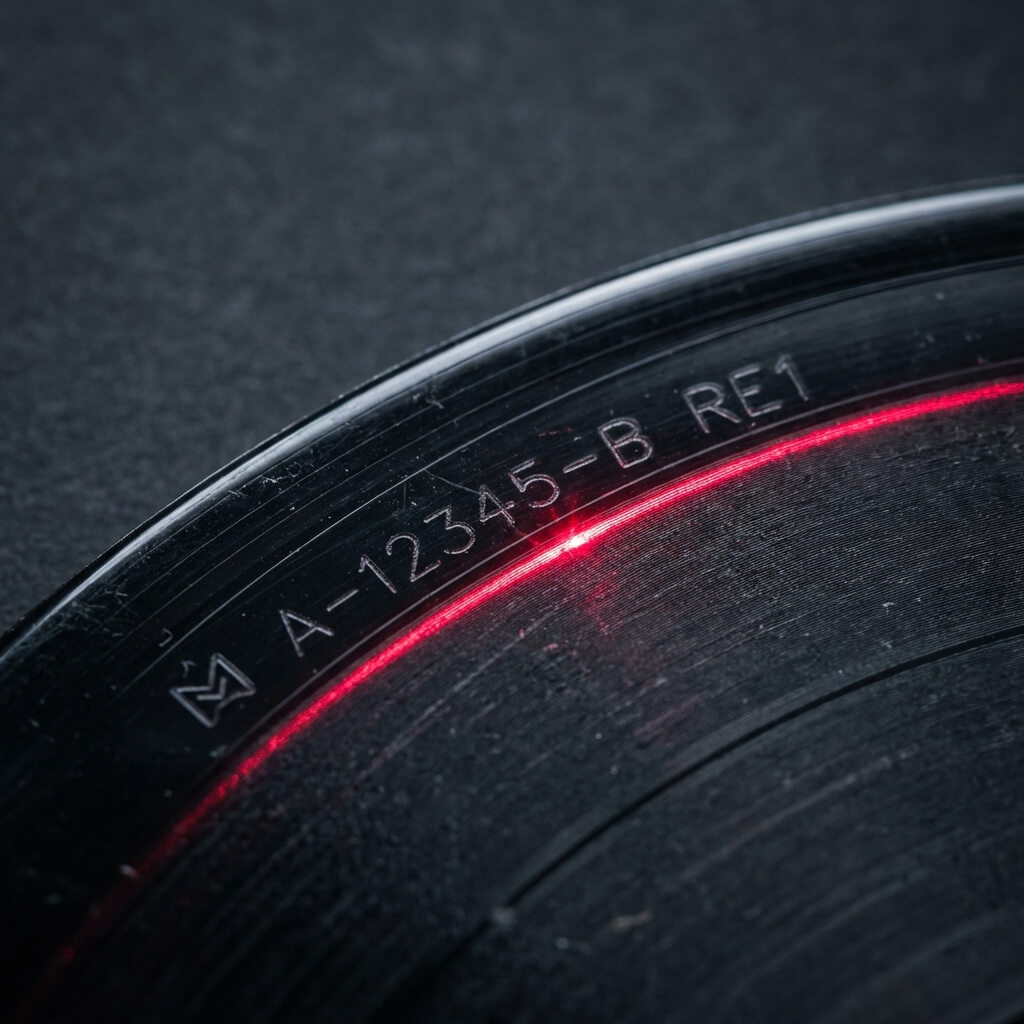
| Rim text | Company names, addresses and wording around the edge | Whether two labels use the same legal/manufacturing text |
| Printed matrix | Side-specific code printed on the paper | A reference to compare with the actual runout |
| Extra marks | Rights-society names, LC code, promo wording | Further clues that require context |
This is a recording checklist, not a universal decoder. Each label had its own practices, which could differ by country, plant and period. A feature that separates two editions of one album may be irrelevant to a different artist’s release.
Identify the imprint without confusing company roles
A record can name a releasing imprint, a parent company, a distributor, a manufacturer and several publishers. They do not all perform the same job. Copying the largest corporate name as the label can lead to a false match, especially when the front logo and the rim text refer to different organizations.
The Discogs submission guidelines emphasize distinguishable physical releases and supporting identifiers. Use the candidate entry’s company roles and images together. If the label has a recognizable imprint but the sleeve names a distributor, record both in your notes instead of forcing them into one field.
Read track credits as carefully as the logo
Publisher names, track-title spelling and the order of credits can differ between otherwise similar labels. Compare the same track on the same side. A listing that says “early label” without showing the relevant credit is offering an interpretation you cannot yet verify.
Do not assume every misspelling is a valuable error. Some errors appeared across substantial production runs, while others were corrected later. You need documentation of the particular variant and evidence of demand before making a rarity or price claim. The physical difference can be real even when the financial significance is unknown.
What the numbers and symbols do—and do not—mean
A printed matrix is not the complete runout
A side-specific code printed on the label can resemble the catalog number. It is not necessarily the full inscription in the smooth area near the label. The runout may add cutting, mastering or manufacturing information that the paper omits.
The Discogs identifier guidelines distinguish a matrix printed on a label from a matrix in the runout. Keep them in separate notes. If you are ready to inspect the inscription itself, use our matrix and dead-wax guide.
A copyright date is not a pressing date
An old date printed on a new record is a common source of mistaken “original pressing” claims. The recording, artwork and later edition may have different dates. In the United States, the ℗ notice described by the U.S. Copyright Office includes the sound recording’s first-publication year. That is not a timestamp for the factory making your individual disc.
Use a printed date as one clue and check the release documentation. Do not infer that a copy was manufactured in 1973 just because the recording notice says 1973. For the broader distinction between an original, repress and reissue, see our edition comparison guide.
An LC code is not an album identifier
An LC code belongs to a rights-administration system; it is not the album’s catalog number or a unique pressing number. Likewise, a rights-society abbreviation should not be treated as a manufacturing-country stamp. Preserve these details because they can help compare labels, but avoid making them carry more meaning than they support.
If the sleeve also has a barcode, that gives another search route, not a substitute for inspection. Our vinyl barcode-scanning guide explains why a successful scan can still leave several plausible editions.
Compare candidates by differences, not overall resemblance
Once you have a few possible releases, create a short comparison sheet. Put your own observations in the first column and record which candidates match them. The aim is to find a distinguishing detail, not accumulate twenty photographs of vaguely similar labels.
Here is an invented example for an imaginary album. These are teaching details, not real release identifiers:
| Observation on your copy | Candidate A | Candidate B | Candidate C |
|---|---|---|---|
| Catalog number ends in “S” | Matches | Matches | No suffix |
| Publisher on side one is North Bridge Music | Matches | Different publisher | Matches |
| Side two rim text includes a street address | No address | Matches | Matches |
None is a complete match. That is a useful result. Your copy could be an unlisted variation, an entry could have incomplete images, or you could have misread one detail. Choose “unresolved” and investigate those possibilities instead of selecting the most expensive candidate.
Now suppose a fourth entry matches both labels. Compare its runouts, country notes, format and sleeve before treating the edition as identified. Two matching center labels substantially narrow the search, but a label design may have continued across more than one manufacturing run.
Common traps when reading labels
Color is vulnerable to photography. Warm lighting, fading, camera processing and screen settings can make one paper stock look like another. Compare wording and layout before relying on shades of red, green or blue. Even real ink differences need context before they become separate cataloged editions.
One side is not enough. Ask for both labels when buying remotely. A difference might occur on side two, and a mixed double album can defeat a search based only on its first disc. Confirm that the number of discs and sides matches the candidate’s format.
A white label is not automatically a test pressing. Blank labels, promotional markings and test-pressing documentation are different evidence. The Discogs format guidelines treat those categories separately. Do not pay a test-pressing premium simply because the paper is white or the sleeve is plain.
An old jacket can contain a later disc. Match the catalog number and format across disc and packaging. Differences deserve an explanation; they are not automatically signs of fraud. A previous owner may have replaced a damaged sleeve without keeping a record of the change.
Label wear is a condition issue as well as an identification problem. Writing can hide a credit, and a sticker can obscure a distinguishing mark. Request another angle rather than peeling it off. Use the Goldmine grading guide for the overall record assessment and describe label defects separately.
What to ask a seller
A precise request makes it easier for a seller to help. Ask for clear photographs of both center labels, the full inscriptions on both runouts, and any sleeve detail that distinguishes the listed edition. Explain the particular uncertainty: “The two versions I found have different publisher credits on side two; could you photograph that area?”
Avoid asking only “Is it original?” The answer depends on territory and edition, and it invites the seller to repeat a label from the listing. Ask what physical evidence supports the stated release. If a valuable edition remains uncertain, a specialist appraisal or inspection may be more useful than another round of image guessing.
Keep an evidence trail as your collection grows
Save the candidate URL alongside your own label photographs, full runout transcription and unresolved questions. A future correction then becomes a small update rather than a complete restart. For historical purchases, keep the original listing description too; it helps distinguish what was claimed from what you later verified.
If you want a mobile starting point for identifying and organizing records, explore DiscSnap for iPhone or Android. Treat suggested matches as leads and verify the physical edition yourself. A camera image cannot establish every runout variant or authenticate a rare record.
The best label identification ends with a reasoned match: these details agree, these details were checked elsewhere, and these questions remain open. That is more useful for buying, cataloging and selling than a confident first-press claim based on color alone.
Prepared by the DiscSnap editorial team on 22 September 2026. Sources are linked beside the relevant explanations; the comparison table is fictional. The original AI-generated hero is conceptual and does not depict a documented label variant.